
Ranking college football programs by historical relevance - Printable Version
+- The CardBoard (https://thecardboard.org/board)
+-- Forum: C-House! (https://thecardboard.org/board/forum-4.html)
+--- Forum: The CardBoard (https://thecardboard.org/board/forum-5.html)
+--- Thread: Ranking college football programs by historical relevance (/thread-24324.html)
+- The CardBoard (https://thecardboard.org/board)
+-- Forum: C-House! (https://thecardboard.org/board/forum-4.html)
+--- Forum: The CardBoard (https://thecardboard.org/board/forum-5.html)
+--- Thread: Ranking college football programs by historical relevance (/thread-24324.html)
Ranking college football programs by historical relevance - msqueri - 08-07-2023
A heuristic for commitment to major college football/appeal to realigning conferences that I mentioned a few times yesterday is how many times major programs have been top 25. For the sake of better understanding who fits in which tiers of this conversation, here's what that looks like based on season-ending AP polls:
All Time Top 25 Seasons
1. Michigan - 63
2. Ohio State - 62
3. Alabama - 60
4. Notre Dame - 58
4. Oklahoma - 58
6. USC - 50
7. Texas - 49
8. Nebraska - 48
9. Penn State - 45
9. Tennessee - 45
11. LSU - 43
12. Georgia - 41
13. Auburn - 40
14. Clemson - 36
15. Florida - 34
15. Florida State - 34
17. Miami - 33
18. UCLA - 31
19. Arkansas - 29
20. Michigan State - 28
20. Texas A&M - 28
22. Washington - 27
23. Iowa - 26
23. Wisconsin - 26
25. Georgia Tech - 25
25. Ole Miss - 25
27. Pitt - 22
28. Syracuse - 21
29. TCU - 21
30. Colorado - 20
30. Stanford - 20
30. Virginia Tech - 20
30. West Virginia - 20
34. BYU - 19
34. Missouri - 19
34. Oregon - 19
37. Maryland - 18
38. Arizona State - 17
38. Duke - 17
38. North Carolina - 17
41. Baylor - 16
41. Oklahoma State - 16
41. Purdue - 16
44. Houston - 15
44. Minnesota - 15
44. Mississippi State - 15
47. Boston College - 14
47. Cal - 14
47. Kansas State - 14
47. NC State - 14
51. Illinois - 13
51. Northwestern - 13
53. Washington State - 12
54. Louisville - 11
54. Oregon State - 11
54. Texas Tech - 11
54. Utah - 11
58. Kentucky - 10
58. South Carolina - 10
60. Virginia - 9
61. Cincinnati - 8
62. Arizona - 7
62. Kansas - 7
64. Indiana - 6
65. UCF - 5
65. Wake Forest - 5
67. Rutgers - 4
68. Iowa State - 3
68. Vanderbilt - 3
21st Century Top 25 Seasons
1. Ohio State - 20
2. Oklahoma - 19
3. Alabama - 17
3. Georgia - 17
3. LSU - 17
6. Clemson - 16
7. USC - 15
8. Florida State - 14
8. Michigan - 14
8. Oregon - 14
8. Texas - 14
12. Florida - 13
12. Wisconsin - 13
14. Notre Dame - 12
14. TCU - 12
14. Virginia Tech - 12
17. Auburn - 11
18. Iowa - 10
18. Penn State - 10
18. Utah - 10
21. Miami - 9
21. Oklahoma State - 9
21. West Virginia - 9
24. Cincinnati - 8
24. Louisville - 8
24. Michigan State - 8
24. Stanford - 8
24. Tennessee - 8
29. BYU - 7
29. Nebraska - 7
31. Baylor - 6
31.Kansas State - 6
31. Ole Miss - 6
31. South Carolina - 6
31. Washington - 6
36. Boston College - 5
36. Missouri - 5
36. Northwestern - 5
36. Oregon State - 5
36. Pitt - 5
36. Texas A&M - 5
36. Texas Tech - 5
36. UCF - 5
44. Arizona State - 4
44. Arkansas - 4
44. Georgia Tech - 4
44. Maryland - 4
44. Mississippi State - 4
44. NC State - 4
44. UCLA - 4
44. Washington State - 4
52. Cal - 3
52. Colorado - 3
52. Houston - 3
55. Illinois - 2
55. Kentucky - 2
55. Minnesota - 2
55. North Carolina - 2
55. Syracuse - 2
55. Vanderbilt - 2
55. Virginia - 2
55. Wake Forest - 2
63. Arizona - 1
63. Duke - 1
63. Indiana - 1
63. Iowa State - 1
63. Kansas - 1
63. Purdue - 1
63. Rutgers - 1
I have a hundred observations about this but for now will leave it here as food for thought and just saw that if Stanford, Cal, Oregon State, or Washington State gets demoted it won't be relegation logic but rather crueler market forces/chance. There are worse programs. Stanford in particular is an above-average program nationally. It would be a travesty for us not to be in one of the major conferences.
If we're talking relegation logic, Vanderbilt, Iowa State, and Rutgers clearly do not belong in major college football. Painfully irrelevant.
RE: Ranking college football programs by historical relevance - Canalejas - 08-07-2023
I would read a good number of those hundred observations.
RE: Ranking college football programs by historical relevance - qwerty49 - 08-07-2023
Very nice post, Matt, and thanks.
I am intrigued by the concept of relegation. And not just because I watched "Ted Lasso." Maybe it makes more sense for professional sports, but hey, we're more than halfway down that road already.
RE: Ranking college football programs by historical relevance - chrisk - 08-07-2023
(08-07-2023, 04:35 PM)qwerty49 Wrote: Very nice post, Matt, and thanks.
I am intrigued by the concept of relegation. And not just because I watched "Ted Lasso." Maybe it makes more sense for professional sports, but hey, we're more than halfway down that road already.
I would guess that only a minority in any conference would support such a concept, even theoretically.
What would have to happen would be for the top schools of the Big 10 and/or SEC to leave the conference and set up a new power conference, leaving the laggards behind. That is essentially what happened when the MWC split from the WAC.
From Wikipedia:
In spring of 1998, BYU and Utah proposed a permanent split into two eight-team divisions. The proposal would have forced some schools into an unnatural alignment because of the geographic distribution of the conference.[3] Air Force was the most strident opponent of this proposal, threatening to become an independent.[3] Soon after the proposal by BYU and Utah, the presidents of Air Force, BYU, Colorado State, Utah, and Wyoming met at Denver International Airport to discuss their future, and they agreed to break away from the WAC to form a new conference.[3] They invited the WAC members New Mexico, San Diego State, and UNLV to join them in what became the Mountain West Conference.
RE: Ranking college football programs by historical relevance - jacket3ree - 08-07-2023
Thanks Matt.
I posted in another thread that Stanford was clearly the best California team of the 2010s and co-best in the Pacific Time Zone with Oregon. Unfortunately, none of that matters. Maryland and Rutgers have no place in the Big Ten historically, but at some point in time, the DC and NYC markets were coveted, so there they are. (The ACC GOR is a direct fallout from Maryland's defection - they knew who the Terps were, and let them off the hook. RIP DG)
Logic is playing no part in any of this.
Logic would lead to a relegation system. Chip Kelly could run it. He gets it.
64 teams in the premier league, geographically organized into 16 groups of four teams. The Pac4 stays like it is. Because. Round robin group play winners proceed to the knockout round as one of 16 seeded playoff teams. For the winning team and runner-up, that is four playoff games. Group play is three games, so 7 total. That leaves anywhere from 5 to 8 non-group games in which seeding and relegation points happen. Cumulative strength of opponents plays a prominent role to avoid nothing but body bag games. There are another 64 or so teams in the FCS (Football Championship Subdivision - Championship? that don't make no sense!) getting their own premier points ™ ready to move up and replace the bottom group finishers every year. Treble points for beating premier league teams and vice versa.
Prove me wrong. :)
RE: Ranking college football programs by historical relevance - jacket3ree - 08-08-2023
To reinforce the bullshittery of all this, Stanford has the third-highest viewership of the conference soon to be known as the former Pac12.
I thought this was all about eyeballs? Well, then WTF?
Stanford is barely behind USC and Oregon in the 2013-2021 period.
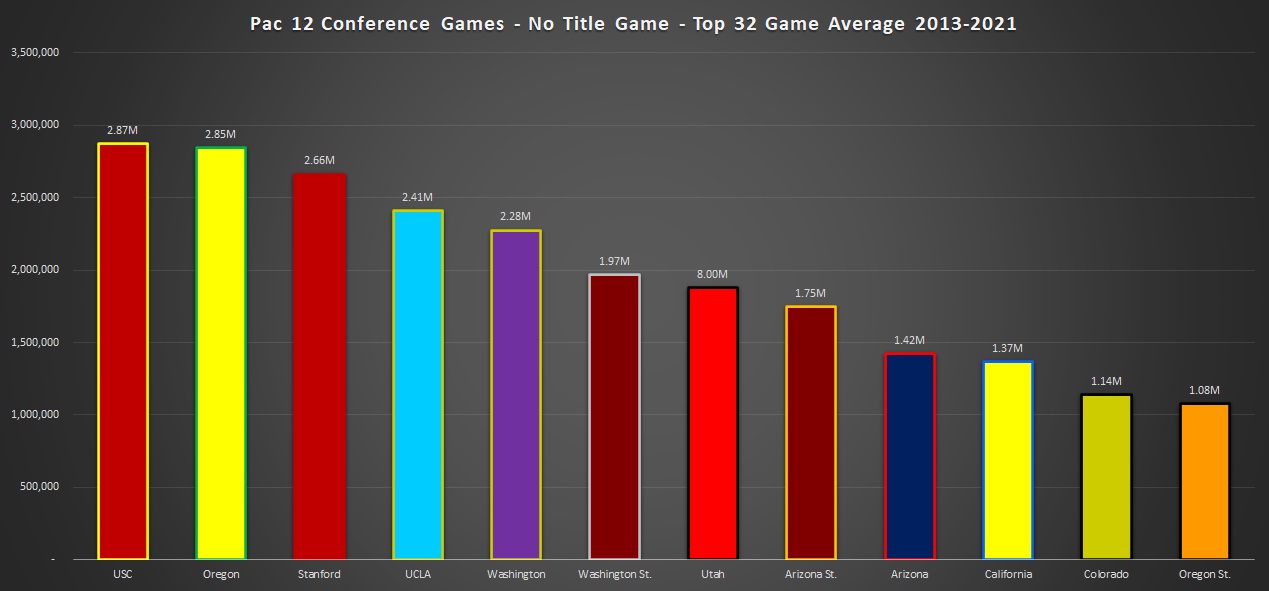
I read somewhere that in the ACC, Stanford would be ahead of everyone except FSU, Clemson, and maybe Miami.
My gut feel is that Stanford really, really wanted to hold the Pac9 together and it wasn't until the last moment it was clear that wouldn't happen. I'm shocked they aren't Machiavellian enough to have had a quick backstabbing fallback like everyone else.
Somewhere on the interwebs is an image of a new MTL research paper showing travel distance isn't so bad, with California stuck on a map of ACC teams but the Colorado River is the Ohio River. I saw it yesterday, but can't find it. Mostly to point out that at the moment, Stanford's academic reputation isn't sterling. One of the ACC sites did say "Stanford is a solid school."
RE: Ranking college football programs by historical relevance - chrisk - 08-08-2023
(08-08-2023, 12:58 PM)jacket3ree Wrote: To reinforce the bullshittery of all this, Stanford has the third-highest viewership of the conference soon to be known as the former Pac12.
I thought this was all about eyeballs? Well, then WTF?
Stanford is barely behind USC and Oregon in the 2013-2021 period.
I read somewhere that in the ACC, Stanford would be ahead of everyone except FSU, Clemson, and maybe Miami.
My gut feel is that Stanford really, really wanted to hold the Pac9 together and it wasn't until the last moment it was clear that wouldn't happen. I'm shocked they aren't Machiavellian enough to have had a quick backstabbing fallback like everyone else.
Somewhere on the interwebs is an image of a new MTL research paper showing travel distance isn't so bad, with California stuck on a map of ACC teams but the Colorado River is the Ohio River. I saw it yesterday, but can't find it. Mostly to point out that at the moment, Stanford's academic reputation isn't sterling. One of the ACC sites did say "Stanford is a solid school."
In the new Pac-12, Stanford and WSU can make a strong case for getting unequal shares.
RE: Ranking college football programs by historical relevance - ColoradoTree - 08-08-2023
I absolutely think some further stratification is going to happen in college football, and relegation/promotion is maybe the most sensible way of making it happen.
That way, all the 133 current FBS schools remain "in the conversation." But in a given year, only 32 or so have a chance at the title, with four 8-team divisions or some such. You might see geographic conferences reemerge in that setting, as Ohio State and Michigan no longer have a financial reason to continue consorting with Rutgers, and the geographic conferences expressly acknowledge unequal distribution based not on the schools in question, but on objective factors such as the number of years in the top division.
Of course, that requires the bluebloods and current elite programs financially to decide that they are OK continuing to subsidize athletic departments at other schools in their conferences, even at a lesser level than they do currently. How long will they be willing to do that? With so much tradition in college football (and college sports generally) having been tossed by the wayside, there's less of an argument for preserving those relationships.
You see it with FSU and the ACC right now, but they're only speaking aloud what dozens of other ADs around the country are thinking.
RE: Ranking college football programs by historical relevance - chrisk - 08-08-2023
In the college football world, relegation happens when the top dogs leave the others behind.
That's what happened when the MWC was formed from the WAC. The Big 12 and Pac 12 are weaker conferences now
because their top teams have moved out and up. With the Big 10 and SEC in the early stages of new media contracts, it doesn't seem likely teams will be leaving them anytime soon.
RE: Ranking college football programs by historical relevance - Goose - 08-08-2023
(08-08-2023, 03:02 PM)chrisk Wrote: In the college football world, relegation happens when the top dogs leave the others behind.True, unless the TV folks decide they cannot afford to honor those contracts as written. Then the haggling starts, because the conferences can't sue the TV folks to force compliance. If they do that, they will be killing their only source of future revenue. Renegotiation will be the result, and the urge to "dump" under-performing teams will be strong.
That's what happened when the MWC was formed from the WAC. The Big 12 and Pac 12 are weaker conferences now
because their top teams have moved out and up. With the Big 10 and SEC in the early stages of new media contracts, it doesn't seem likely teams will be leaving them anytime soon.
RE: Ranking college football programs by historical relevance - jacket3ree - 08-08-2023
I plan to spend the rest of my pathetic life pushing the geographic organization/relegation concept. That, and correcting the constant misuse of X games over 500. If D. Fleming still reads here, I need a word with you.
RE: Ranking college football programs by historical relevance - msqueri - 08-08-2023
(08-08-2023, 12:58 PM)jacket3ree Wrote: To reinforce the bullshittery of all this, Stanford has the third-highest viewership of the conference soon to be known as the former Pac12.
I thought this was all about eyeballs? Well, then WTF?
Stanford is barely behind USC and Oregon in the 2013-2021 period.
I read somewhere that in the ACC, Stanford would be ahead of everyone except FSU, Clemson, and maybe Miami.
My gut feel is that Stanford really, really wanted to hold the Pac9 together and it wasn't until the last moment it was clear that wouldn't happen. I'm shocked they aren't Machiavellian enough to have had a quick backstabbing fallback like everyone else.
Somewhere on the interwebs is an image of a new MTL research paper showing travel distance isn't so bad, with California stuck on a map of ACC teams but the Colorado River is the Ohio River. I saw it yesterday, but can't find it. Mostly to point out that at the moment, Stanford's academic reputation isn't sterling. One of the ACC sites did say "Stanford is a solid school."
I think all those viewership numbers tell us is that Stanford was a great team for most of that 2013-2021 period. There may be some teams with sufficient brand and fan base that people will watch them regardless but I don’t think we’re one of those teams. People will watch us when we’re in good games and won’t when we aren’t. Looking at anything in the last decade is cherry-picking, not the kind of analysis tv executives will or should be doing. What they should do is look at a program’s long-term, structural likelihood of playing good games. We are a bit above average from that vantage.
If one were to look at tv ratings, the salient comparisons to where we are now are the periods immediately following 1984, 1989, 1995, 2005, and 2007. (Well, some more salient than others due to shifts in the media landscape making it apples to oranges) One should look at the ratings Walt Harris and Jim Harbaugh mustered more than what David Shaw did. I bet this would be pretty middling, which is kind of our lot in the football life and, by the way, should absolutely have a seat at a major conference table.
RE: Ranking college football programs by historical relevance - jacket3ree - 08-08-2023
I agree Stanford was good and interesting during that period, which was not that long ago. I think it would also be cherry picking to just look at Stanford only when coming off periods of suckage. Your overarching point that Stanford deserves a seat at a table hosting the likes of Northwestern, Vanderbilt, Rutgers, Indiana, Purdue, and Minnesota is valid. I mean even UCLA and Washington. And Colorado? They suck out loud in football. The world we live in is one in which Coach Prime's persona is more important then the lack of achievement since a 5th down gave them an illegitimate title. (Do I remain bitter about that? Yes. And Stanford beat them on the field that year too. Just because they were in Boulder did some chickenshit referees, probably from the Pac10, deem Eric Bieniemy's helmet maybe getting over the goal line a TD. I hope they lose every football game they play for the rest of time. I'd even pull for UGA over them, which is....insane.)
My overarching point is that the people making these decisions appear to be morons. Which makes figuring out what to do challenging.
RE: Ranking college football programs by historical relevance - msqueri - 08-08-2023
To be clear, I was not cherry-picking periods of suckage. I picked periods immediately following periods of suckage. Those are the periods most relevant to where we are now and are the most neutral, non-cherry-picked periods you can get. Sometimes Stanford has made great hires in those circumstances, sometimes ok hires, and sometimes terrible hires. That’s the point. Those periods tell a thoughtful person (agreed with you that powers that be these days may not be that) what a reasonable expectation for Stanford football would be.